
Innozinc and Innozinc-h protect cable trays, rack frames, seismic supports and threaded rods with Ceramic Galvanizing. KEMP develops component specifications around corrosion resistance, dimensional tolerances and assembly conditions, including galvanic-corrosion assessment for dissimilar-metal interfaces.
Controlled rooms still require management of electrical contamination and electrochemical corrosion. Also consider fabrication, coating coverage and component assembly.
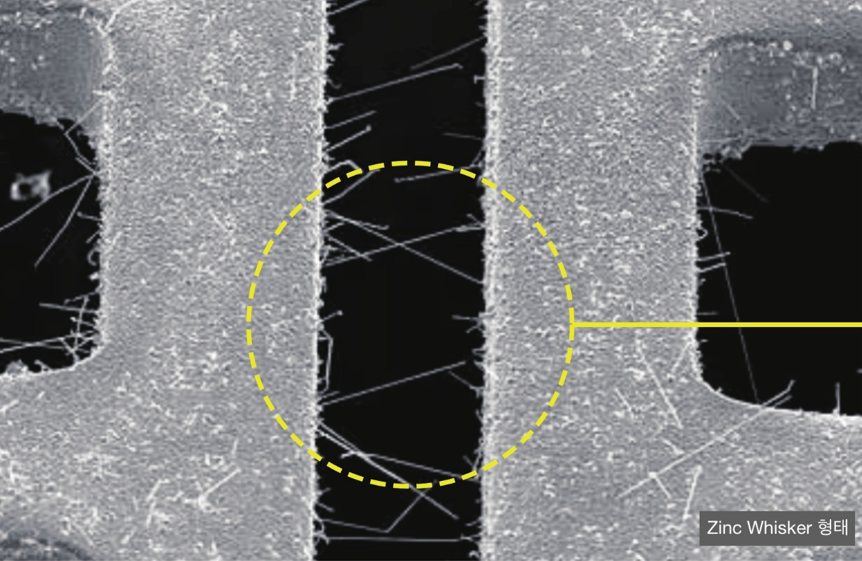
Zinc whiskers are conductive metallic filaments that can grow from zinc-coated surfaces. Their growth and incubation vary. NASA has documented electronic failures associated with whisker contamination, including zinc-coated raised-floor structures. Assess the actual equipment and particle pathways.
Thickness alone does not determine whisker risk. Published experiments describe thickness-dependent behaviour under particular plating conditions, not a universal safe or unsafe threshold for all data-center components.
Define contamination controls before material approval Background references: NASA, Brusse & Sampson (2004); Takemura (1986); Wu, Ashworth & Wilcox (2015). These do not validate Innozinc whisker suppression.Stainless-steel fasteners contacting zinc-coated steel can create galvanic interfaces when an electrolyte is present. The cited Innozinc-h comparison reported 65% lower galvanic current density with a carbon-steel counterface than its HDG reference. This value must not be attributed to an SUS304-bolt joint.
Assess electrolyte, area ratio and counterfaceReview salt, condensation and chemical exposure separately. Innozinc-h SST guidance is 1,500–2,000 hr. The cited 10% HCl, three-minute immersion result does not qualify continuous acid service.
SST: 1,500–2,000 hr · Chemical compatibility reviewPre-coated Zn–Mg–Al sheet is cut and formed after coating. Review cut-edge coverage, bend damage and fabrication stresses. Although stress can contribute to whisker growth, it does not establish whisker behaviour for a particular sheet product. Obtain relevant supplier data.
Post-fabrication coating can cover accessible edges Background: stress and microstructure research; obtain product-specific data for any coating comparison.Whisker growth can involve internal stress and microstructure. Reported stress thresholds and deposit stresses depend on the study conditions; they are not universal design limits. Electro-zinc coatings need application-specific risk review. KEMP's polarization comparison reported a 96% lower corrosion-rate estimate than its HDG reference, but did not measure whisker growth.
Polarization evaluates electrochemical corrosion behaviour under the test conditions. It does not measure whisker incubation, density, growth rate or electrical safety.
A comparison with a zinc-coated reference cannot establish delayed whisker initiation or slower whisker growth. Those claims require direct, product-specific evidence.
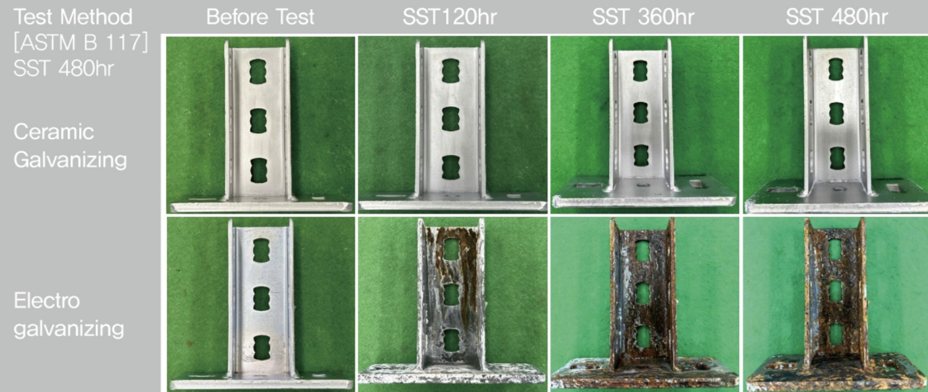
The coating system should be evaluated against the required corrosion and assembly conditions.
Define the qualification criteria for components near sensitive electronics.
Innozinc is not represented as whisker-free. Nor does reduced corrosion establish later initiation or slower whisker growth. Direct evidence is needed under relevant material, process and environmental conditions.
Darkening, white rust and whisker growth are not an established fixed sequence. Inspect discoloration against the agreed appearance and corrosion criteria. Visual inspection alone cannot establish whisker absence or timing.
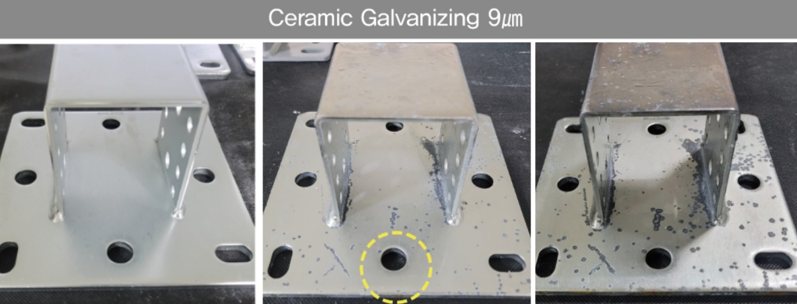
Whiskers may create conductive contamination. The illustration does not predict growth rate or compare coating systems quantitatively.
Electrodeposited zinc with an inorganic layer. Corrosion results do not establish whisker suppression.
Inspect joints as part of operation & maintenance. Compare galvanic current under a defined counterface, electrolyte and area ratio, not generic material rankings.
Both use a ceramic zinc coating system. The appropriate grade, thickness and process depend on exposure, component geometry and acceptance criteria. Whisker-sensitive applications require separate qualification.
A project may consider Innozinc and Innozinc-h in different exposure zones. Share drawings and performance requirements to agree the specification and validation plan.
Catalogue references and current grade guidance. Comparisons require equivalent test conditions and acceptance criteria.
SUS304 is a base material, not a zinc coating. Zinc white-rust criteria do not apply to it; the reference does not establish direct equivalence.
| Item | Zinc electroplating | Hot-dip galvanizing | Innozinc | Innozinc-h | SUS304 (base material) |
|---|---|---|---|---|---|
| SST reference / grade guidance | 240 hr (reference) | 500 hr (reference) | 720–1,000 hr | 1,500–2,000 hr | Not a zinc white-rust criterion |
| 10% HCl, three-minute screening | Poor (catalogue rating) | Poor (catalogue rating) | Fair (catalogue rating) | Good (catalogue rating) | Good (catalogue rating) |
| Polarization corrosion comparison | – | Reference: 100% | Reported 96% reduction | Reported 96% reduction | – |
| Galvanic comparison: test-specific rating | Poor (catalogue rating) | Poor (catalogue rating) | Good (catalogue rating) | Very good (catalogue rating) | Fair (catalogue rating) |
| Whisker qualification | Application-specific evidence required | Application-specific evidence required | Suppression not established | Suppression not established | Not a zinc coating |
| Coating Thickness | 8µm↑ | 50~77µm | 8µm↑ | 8µm↑ | – |
| Fastener fit / tolerances | Verify specified system | Verify specified system | Verify specified system | Verify specified system | Verify specified system |
| Topcoat adhesion | Verify specified system | Verify specified system | Verify specified system | Verify specified system | Verify specified system |
| Process temperature / dimensional review | Ambient electrodeposition | Hot dipping, approximately 450°C | Ambient electrodeposition | Ambient electrodeposition | – |
| Chemical screening / compliance review | Specification-dependent | Specification-dependent | 26-analyte reference; confirm report scope | 26-analyte reference; confirm report scope | Confirm material compliance requirements |
References include ASTM B117 salt spray conditions (5% NaCl, 35°C) and three-minute immersion in 10% HCl. Request the original KTR reports, including specimen preparation and the analytes actually tested. IEC 62321-6 is not a blanket test for all RoHS substances. These comparisons support review, not automatic approval.
Choose the grade by exposure and function; verify electrical, contamination and mechanical requirements separately.
Thin deposits can support close tolerances, but thread fit and hole clearance must be verified on coated production parts. Repair any reworked surfaces as specified.
Request analyte-specific reports and detection limits for the applicable material-approval checklist. A 26-analyte screen does not automatically establish RoHS, cleanroom or equipment approval.
Ambient-temperature electrodeposition can reduce heat-related distortion risk. Confirm handling, geometry and the full process for thin or long components.
Cutting or punching pre-coated sheet exposes edges. Coating after fabrication can cover accessible surfaces; confirm recesses, weld preparation and the required repair process.
The cited topcoat evaluation reports 9.05 MPa / 6.20 MPa for its tested systems. Confirm paint, preparation, curing and adhesion method in the original report; do not treat ISO 20340 as the pull-off test method.
Request process and carbon-assessment inputs, including system boundary, energy mix and production assumptions. No quantified lifecycle reduction is established here.
Coating changes may require customer and engineering approval. KEMP can help prepare the relevant reports and specification information.
Share your component and requirements so relevant reports and the technical catalogue can be identified.
Agree sample quantity, fees, shipping and acceptance criteria. A representative dissimilar-metal joint can support assembly testing; confirm the test counterface and conditions.
Agree SST, galvanic, thickness, adhesion and any separate whisker qualification with the responsible laboratory. Request methods and raw data where available.
Request draft specification wording, relevant references and technical explanations. Engineering participation can be arranged as needed.
Place production orders after approval of the relevant grade, process controls and acceptance requirements.
The available project summary describes work from 2026. Confirm the current supply and approval status for each named application.
KEMP began supplying threaded rods and cable trays for Korean data-center projects in June 2026. Contact our team for component specifications and application details.
Ceramic zinc coating is under review for pipework and structural sections. Confirm sample and approval status; do not describe it as whisker-reducing without direct evidence.
The available summary describes review of pipework, cable trays, seismic supports and brackets. Confirm current status and approved scope.
Project identities and reference details are available subject to confidentiality and disclosure permissions.
KEMP has coating references across power, heavy industry, shipbuilding and construction. Data centers are an application-development focus requiring project-specific technical review.























Logos relate to KEMP's broader industrial supply references, not proof of data-center qualification or endorsement of this page's claims.
Questions for technical specification review.
Find the service environment and technical review points closest to your project.
