Innozinc
SST 720–1,000 hr
Ceramic Galvanizing combining corrosion resistance with post-plating formability.
Innozinc Features
KEMP · HIGH CORROSION RESISTANCE
 High corrosion resistance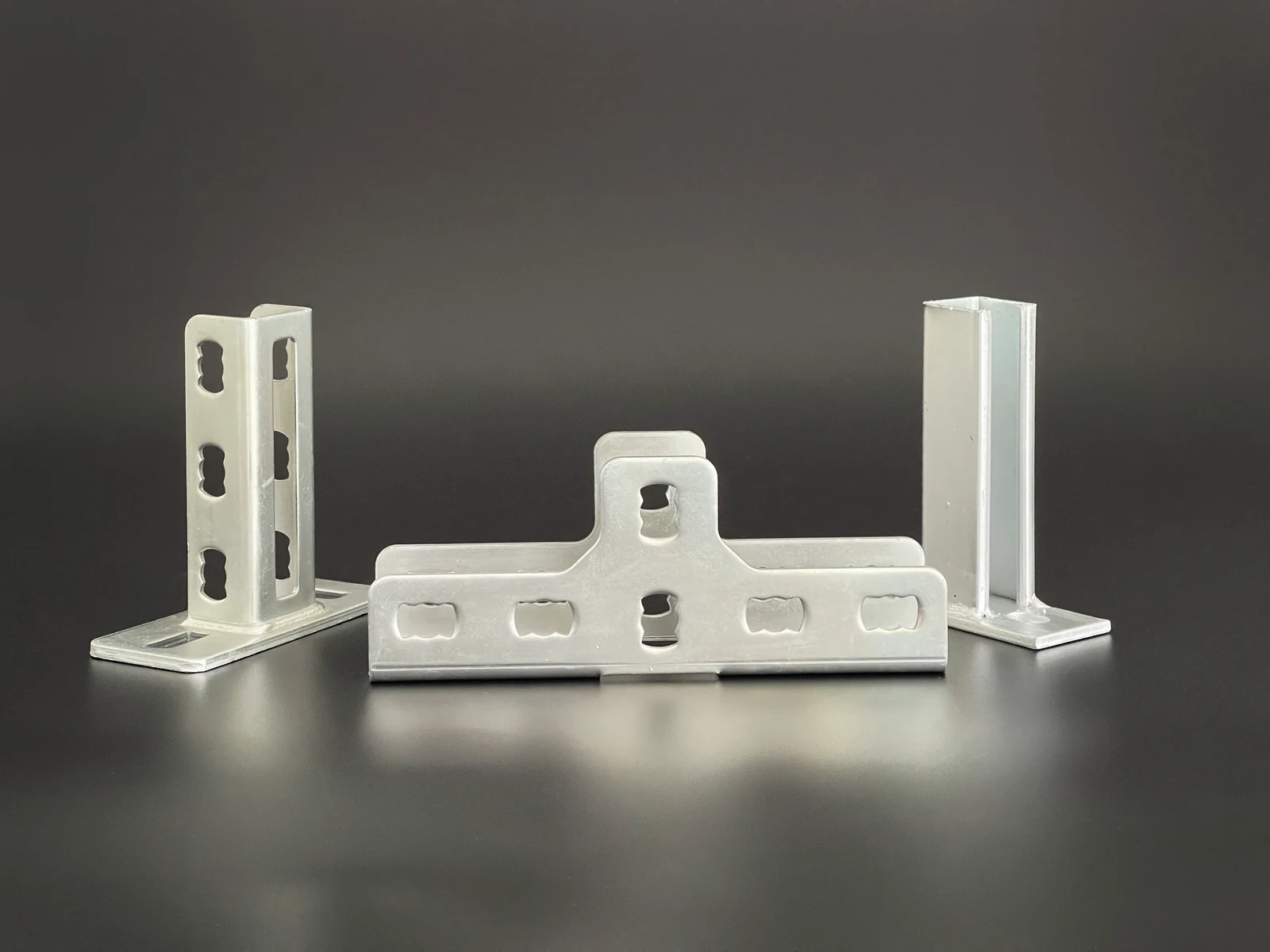
For components and steel structures exposed to coastal, marine or condensation conditions.
Review corrosion requirements together with fabrication and assembly conditions.
Strut-channel brackets
INNOZINC-H · HIGH CORROSION RESISTANCE
Innozinc-h is high-corrosion-resistance Ceramic Galvanizing for components and steel structures in saline and humid environments. Its representative SST specification of 1,500–2,000 hr supports corrosion protection for structures and their joints.
CORROSION RESISTANCE
Salt Spray Test · SST
1,500–2,000 hr
Innozinc-h: SST 1,500–2,000 hr. Standard Innozinc: SST 720–1,000 hr.
View Standard InnozincRepresentative SST specification: 1,500–2,000 hr. The specification includes plating thickness, substrate, pretreatment and white- and red-rust acceptance criteria.
Corrosion resistance, adhesion and formability support the specification of Innozinc-h for industrial components.
The performance table presents results alongside their test methods. We define detailed specifications for the substrate, part geometry and service environment.
FABRICATION & ASSEMBLY
Welding, bending, threaded assembly and topcoating are integral to the surface-treatment specification.
We incorporate welding, forming and fastening requirements into the product specification. Sample evaluation establishes quality-control and post-treatment conditions for fabricated areas.
Coating schematic: an average 8 µm zinc–ceramic composite layer on steel, compared at the same scale with a hot-dip galvanized coating of 50 µm or more.
Innozinc brand coating-structure schematicSalt, condensation and dissimilar-metal contacts inform the coating and joint specification. We connect corrosion-performance requirements with joint design to improve component protection.
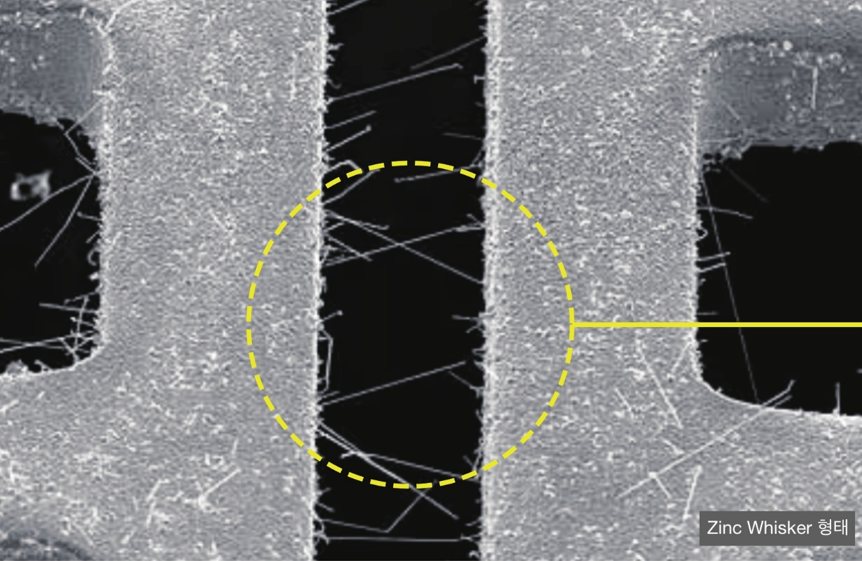
Scanning electron microscopy (SEM) shows needle-like zinc whiskers growing from a zinc-plated surface. Detached conductive crystals can cause short circuits in electrical and electronic equipment, making whisker control relevant to data centers and electrical installations.
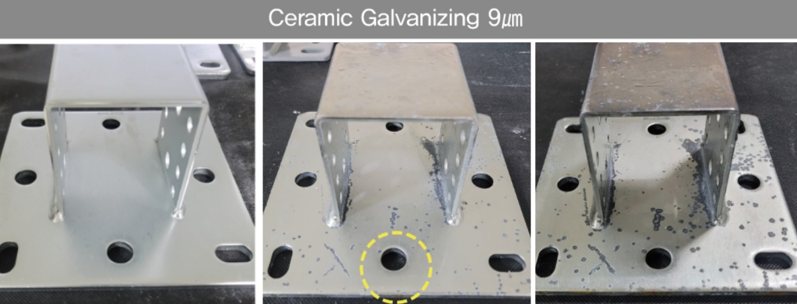
Dark staining on a zinc-plated surface illustrates changes associated with repeated moisture, condensation and salt exposure. Surface-quality management addresses both discoloration and corrosion protection.
Images: SEM observation of zinc whiskers and examples of black staining on zinc-coated surfaces. KEMP develops Innozinc-h application specifications for the metal pairing and service environment of each joint.
Applications include components and structures exposed to seawater, salt and condensation, with demanding fabrication and assembly requirements. Plating specifications are tailored to customer requirements.
Frequent seawater, salt and condensation exposure, often with dissimilar-metal joints.
Exposed steel structures and dissimilar-metal contacts. Selection at the design stage is important where later rework is difficult.
Road installations requiring long-term outdoor durability.
Corrosion protection for structures with long-term outdoor exposure.
Components requiring both corrosion resistance and fabrication or assembly compatibility.
Surface-treatment specifications integrate cutting, welding and forming requirements with coating integrity and corrosion protection.
Environments requiring management of galvanic corrosion at stainless-steel bolt contacts and conductive debris such as zinc whiskers.
Corrosion-resistance, adhesion and fabrication results are presented with their test methods. Detailed specifications follow the relevant grade and specimen conditions.
| Test item | Result | Test method |
|---|---|---|
| Salt spray test (SST) | 1,500–2,000 hr | ASTM B117 / KS D 9502 |
| Cyclic corrosion test (CCT) | 80 cycles | JIS H 8502 |
| Adhesion | 5B | ASTM D3359-17 |
| Topcoat adhesion | 3 MPa or higher | ISO 20340 Paints and varnishes |
| Weldability | No defects | Radiographic Test (RT) |
| Pencil hardness | 9H | ASTM D3363-05 |
| 26 hazardous VOCs in the solution | Not detected | KS M ISO 11890-2:2014 (GC/FID) |
| Solution — RoHS assessment | Not detected | IEC 62321-6 Ed. 1.0 : 2015 |
Test conditions and acceptance criteria follow the relevant technical data. VOC and RoHS results refer to the substances analyzed and their respective detection limits.
ONE BRAND, TWO PRODUCTS
Standard and high-corrosion-resistance grades address different corrosion-performance requirements and manufacturing processes.
SST 720–1,000 hr
Ceramic Galvanizing combining corrosion resistance with post-plating formability.
Innozinc FeaturesSST 1,500–2,000 hr
High-corrosion-resistance Ceramic Galvanizing for demanding industrial components.
You are viewing this productSpecify corrosion performance using SST, plating thickness, white- and red-rust acceptance criteria, substrate and pretreatment.
Incorporate welding, bending, thread tolerances and dissimilar-metal joint conditions into the component specification.
Evaluate total process economics, including consumables, inspection, repair and maintenance requirements.
NEXT STEP
Share the substrate, geometry, drawings and service environment. We develop the plating specification around the required standard and post-plating fabrication conditions.