
Fine-mesh openings, serrations and fastening holes need controlled coating thickness as well as corrosion protection. Innozinc Ceramic Galvanizing combines an approximately 8 μm deposit with ambient-temperature processing to retain functional dimensions and reduce thermal distortion. The cited comparison recorded 1,000 hr SST performance; current Innozinc specifications cover 720–1,000 hr.
Innozinc manages batch variation by standardizing plating thickness, post-treatment and process conditions. Specimen preparation and red-rust acceptance criteria are set against the grating's required corrosion grade.
Corrosion requirements and test method
The comparison references the association standard's 500 hr requirement and the KS D 9502 test method. The 480 hr and 1,000 hr figures are recorded red-rust results for the respective specimens. Product documentation identifies thickness, pretreatment and customer inspection conditions.
Revised requirements recognizing equivalent or better performance provide an application route for Ceramic Galvanizing alongside process-specific surface-treatment specifications.
Standard provisions are summarized here. Request application-support documentation with the original clauses relevant to your specification or project requirements.
Control thermal distortion, preserve functional geometry and match the coating to the exposure environment.
Grating grids, long posts and frames require careful distortion control. Innozinc's approximately 25 °C plating process reduces high-temperature immersion exposure and supports flatness and dimensional precision.
Ambient plating at 25 °CCoating thickness affects fine-mesh spacing, anti-slip serrations and effective hole dimensions. Innozinc's approximately 8 μm thin deposit limits profile change and supports post-plating dimensions within design tolerances.
Approximately 8 μm plating · Geometry retentionGrating, guardrails and drainage covers experience de-icing salts and cyclic wetting. Representative specifications of SST 720–1,000 hr for Innozinc and 1,500–2,000 hr for Innozinc-h support coating selection for the service environment and procurement requirements.
Innozinc 720–1,000 hr · h 1,500–2,000 hrThe table and chart show recorded red-rust test values. Current representative SST specifications are 720–1,000 hr for Innozinc and 1,500–2,000 hr for Innozinc-h. Request a comparison aligned with your acceptance criteria and specimen conditions.
Test metric: the comparison uses a red-rust criterion. Technical documentation specifies white-/red-rust acceptance criteria and coating thickness. SST measures corrosion performance under defined test conditions, rather than years of outdoor service.
Thin Innozinc plating supports precise control of fine-mesh openings, anti-slip profiles and bolted interfaces. Ambient-temperature plating also reduces thermal-distortion exposure in sheet and roll-formed components.
| Characteristic | Zinc electroplating | Hot-dip galvanizing | Innozinc | Innozinc-h |
|---|---|---|---|---|
| Corrosion resistance (SST, red-rust criterion) | 90 hr | 480 hr | 1,000 hr | 1,500 hr+ |
| Cyclic corrosion test (CCT) | 5 Cycle | 40 Cycle | 80 Cycle | 80 Cycle↑ |
| Corrosion resistance after mechanical damage | 90 hr | 240 hr | ≥500 hr | ≥500 hr |
| Coating thickness | 8 μm | 55~120 μm | 8 μm | 8~15 μm |
| Process temperature | Ambient temperature | 400~500 ℃ | Ambient plating at 25 °C | Ambient plating at 25 °C |
| Bend formability | Requirement not met in the cited comparison | Requirement not met in the cited comparison | 140° bend requirement met | Good |
| Weldability | Poor | Poor | Good | Good |
| Chromium treatment | Trivalent / hexavalent chromium | Hexavalent-chromium post-treatment | Chromium-free options | Chromium-free options |
Sources: KEMP R&D comparative data; KTR test results; joint R&D with Korea Shipbuilding & Offshore Engineering and Hyundai Heavy Industries.
Plating quotations reflect geometry, specific surface area, weight and monthly production volume. Send drawings and a production plan for a process specification and supply proposal.
Request a Quotation →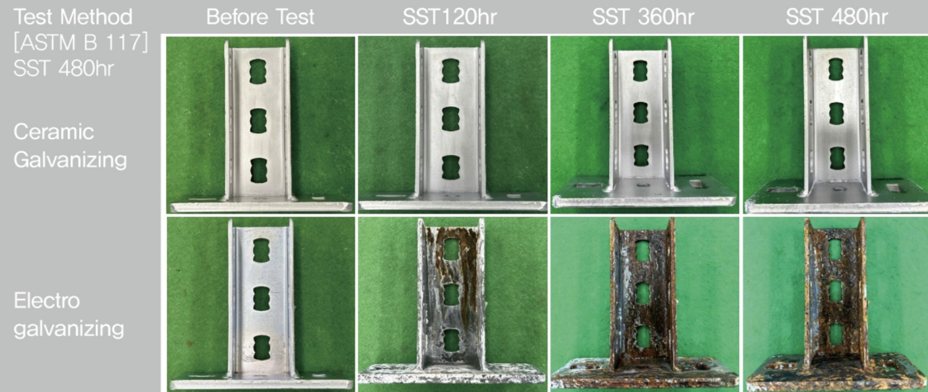
Innozinc and Innozinc-h are selected according to exposure conditions and required corrosion resistance.
Ambient-temperature electrodeposition reduces LNG use for heating a zinc bath. It limits thermal-distortion exposure in thin roll-formed members and welded grids, while supporting plating after fabrication.
Welding without prior zinc removal can reduce masking and coating-removal operations. The cited shipyard comparison recorded 45 minutes less welding labor for the same 250 mm angle task.
Reported welding-fume concentration: 27.64 mg/m³ versus 57.72 mg/m³ for the mild-steel reference. Reported coating burn-damage width: 0.8 cm versus 2.4 cm. Separate forming assessments cover a 140° bend and roll grooving.
Innozinc combines chromium-free processing with an inorganic ceramic film for corrosion resistance. Process specifications and substance-analysis data are provided against customer environmental requirements.
KEITI assessment documentation provides the basis for the cited carbon-reduction comparison. Request the underlying process and emissions data needed for your procurement documentation.
KEMP's Ulsan plant operates rack, acid-zinc and barrel plating lines. Stated daily capacities are 35, 10 and 7 tonnes respectively. Product-specific routing and production planning support supply schedules.
KEMP provides test documentation, relevant standard clauses and quality criteria for surface-treatment approval by the customer or supervising engineer. Product-specific samples and technical documentation support specification changes.
Tell us the product and procurement requirements. We will email the relevant test documentation and standard clauses.
Drawings and production conditions guide the sample plating specification. Assessment covers fine-mesh spacing, anti-slip profiles, bolt-hole dimensions and surface quality.
Testing follows your white-/red-rust criteria and specimen conditions, with documented results. The assessment can establish conformance to the applicable 500 hr requirement.
We prepare draft specification wording, relevant standards and application records. A KEMP engineer can participate in the technical presentation where needed.
Following approval, the project moves to regular orders. Product specifications identify the selected Innozinc or Innozinc-h grade.
Marine steel outfitting has been supplied for more than 60 vessels at two major shipbuilders. KEMP's cited supply record covers over 80% of the Korean grooved fire-protection fitting market, with customers in power generation, heavy industry, construction and process plants.



















The logos represent KEMP's company-wide supply record. Ask our team for product-specific grating and road-infrastructure application examples.
Technical guidance on product specifications, corrosion assessment and production quality control.
Discover KEMP surface-treatment solutions for industry-specific exposure conditions and product requirements.