What challenges does HiGANiC address?
It is a protective coating designed to reduce corrosion-related deterioration of heat exchangers and components made from non-ferrous metals such as aluminum and copper.


HiGANiC is an organic–inorganic hybrid semi-ceramic coating for heat exchangers and non-ferrous metal components. It combines the flexibility of organic constituents with the heat and corrosion resistance of inorganic constituents to inhibit fin and coil corrosion and help maintain heat-transfer performance. Clear and Silver specifications are selected to suit the substrate, component geometry and operating environment.
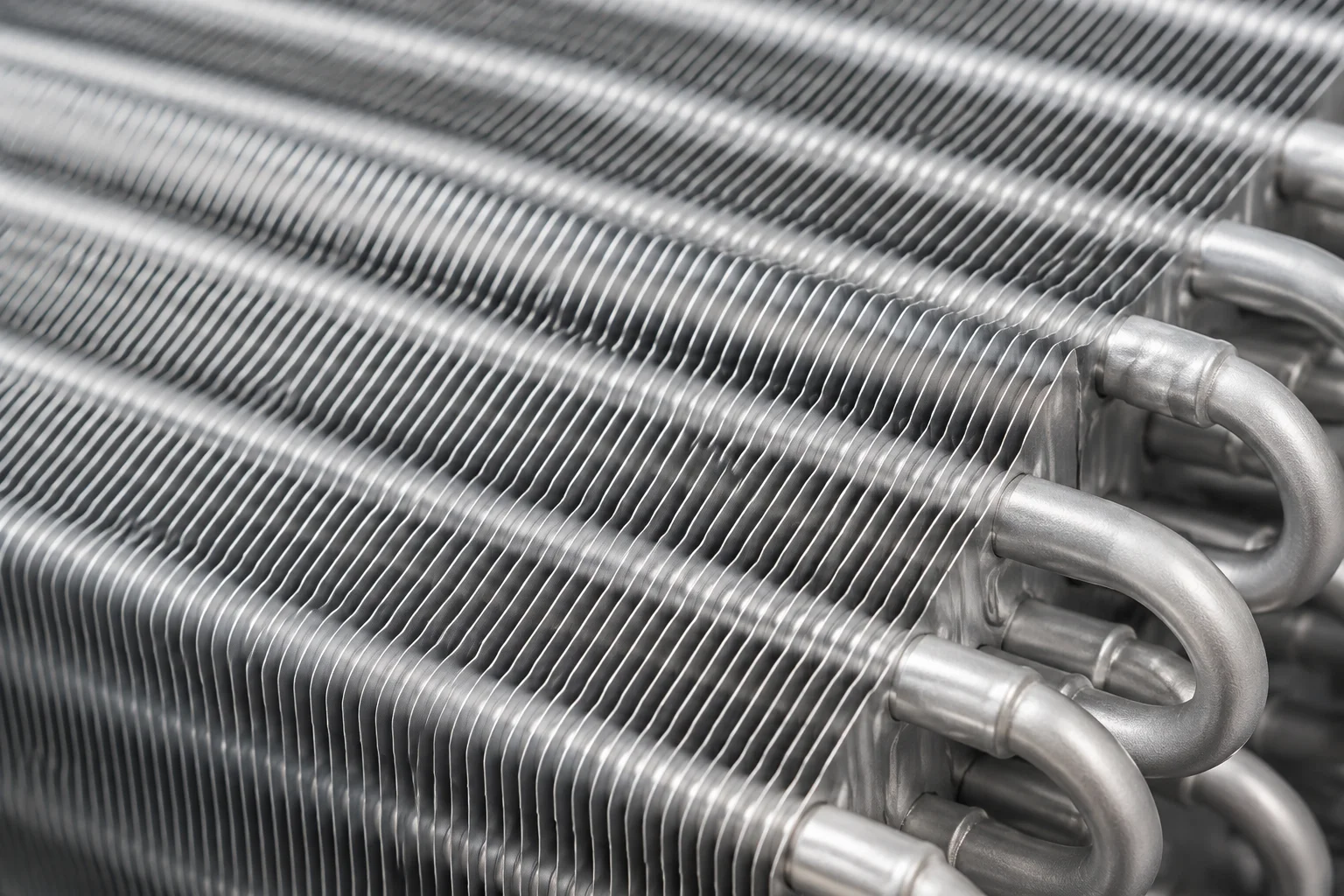
Based on KTR test reports and the product technical data sheet (TDS).
Air handling units, coils, ducts and unit coolers can be exposed to condensation, salt, moisture, UV radiation and corrosive gases. Assemblies joining aluminum, copper and zinc may also be susceptible to galvanic corrosion.
Corrosion and whitening of fins can impair heating and cooling efficiency and precise temperature control.
Corrosion can reduce housing strength and increase the risk of leakage.
Progressive corrosion can increase energy consumption and maintenance costs.
Corrosion can release aluminum-oxide or zinc-oxide particulates into the air.
Available in two types: a clear formulation with non-metallic constituents and a bright metallic-silver formulation containing zinc and aluminum.
Clear Coating
A clear formulation with non-metallic constituents. Its electrical insulation properties, including a reported 25 A current-isolation test, support evaluation for dissimilar-metal interfaces and precision environments sensitive to conductive contaminants, such as data centers and cleanrooms.
Bright Metallic-silver Coating
A silver formulation containing zinc and aluminum for protection against external corrosive agents. The application record includes demanding environments such as seawater and desalination facilities.
HiGANiC combines corrosion resistance, heat resistance and thin-film application to improve the surface protection of heat-exchanger components. Test data and application records support specifications for replacing imported coatings and defining component-specific coating processes.
| Property | KEMP HiGANiC | Imported Product B |
|---|---|---|
| Coating Type | Organic–inorganic hybrid (semi-ceramic) | Organic coating (polyurethane) |
| Corrosion Resistance (SST) | 4,000 hr or more | 4,000 hr or more |
| Coating Thickness | 20–25 µm (thin film) | 25~30㎛ |
| Reported Temperature Range | -45 ~ 400℃ | -40 ~ 200℃ |
| Heat-transfer Performance | Very good (temperature difference below 1°C) | Good (reported heat dissipation increase of 2–3%) |
| Weathering Resistance (QUV) | 600 hr — ΔE 0.2; 99% gloss retention | No data provided |
| Surface Hardness / Adhesion | 5H pencil hardness / 5B adhesion | No data provided |
| VOC / Environmental Testing | Meets the referenced indoor-air-quality criteria; reported RoHS items not detected | No data provided |
| Electrical Insulation | 25 A current isolation in the reported test | No data provided |
| Application References | Supplied since 2016 · approximately 200 sites | - |
Based on the property comparison sheet and KTR test reports. Imported-product figures are taken from the manufacturer's published information.
Results from testing conducted by accredited laboratories, including the Korea Testing & Research Institute (KTR).
Color difference ΔE 0.2; 99% gloss retention
Pencil hardness: 5H; adhesion: 5B
Impact resistance: 12 N·m
Mass loss measured in the Taber abrasion test
Aluminum substrate; thin-film coating for heat-transfer applications
Reported indoor-air-quality test results: TVOC 0.239 mg/m²·h; formaldehyde and toluene below 0.005. Refer to the report for measurement units and assessment criteria. Heat-curing condition: 200°C for 20 minutes.
Application conditions are evaluated for each substrate, including aluminum, copper and magnesium, as well as stainless steel and galvanized sheet (GI and EGI).
Helps maintain heat exchange efficiency by protecting fins and coils against corrosion.
Helps protect against corrosive agents while supporting heat-transfer performance.
Coats galvanized steel surfaces to help control whitening and corrosion.
Protects substrates exposed to demanding conditions such as condensation and salt.
Evaluate the Clear formulation for precision environments.
Application experience includes environments with significant salt exposure.
KEMP reports continuous supply since 2016 with no performance complaints in the referenced supply record.
Reported applications cover more than 200 sites, including seawater and desalination facilities, public buildings, hospitals, libraries, swimming pools and mixed-use developments.
Used in products designated as Excellent Products by Korea's Public Procurement Service and supplied to public-sector and research facilities.
Tell us the substrate, service environment and expected volume so we can recommend a specification.
Apply the coating to the intended substrate and evaluate the required properties and process compatibility.
Agree on the coating specification and the pretreatment, application and curing conditions.
Move into production coating with quality management and follow-up technical support.
Considerations for protecting aluminum and copper heat exchangers and other non-ferrous components.
It is a protective coating designed to reduce corrosion-related deterioration of heat exchangers and components made from non-ferrous metals such as aluminum and copper.
An organic–inorganic hybrid coating combining the flexibility of organic constituents with the thermal and corrosion resistance of inorganic constituents.
Review the substrate, heat exchanger geometry, target coating thickness, thermal and chemical exposure, and required test standards before sample evaluation.
Share the substrate, drawings or photos, sample quantity and service environment. Our team will confirm the coating specification, sample-treatment cost and schedule.